MeCCSA Outstanding Achievement Awards – 2026

The MeCCSA Awards recognise outstanding research in the fields of media, communication, and cultural studies.
These are the shortlisted entries for the 2026 awards. Eligible outputs were those published/released in public domain in 2025 and nominated by peers.
Award winners will be announced during the MeCCSA Annual Conference 2026, hosted by Leicester University, 2-4th September 2026.
MeCCSA Bursary Awards – 2026
There was a strong field of applications from PhD students for our annual bursary awards to assist in attending the MeCCSA conference.
The winners are:
Waqar Arif (De Montfort, Leicester), Chi Zhang (University of Leeds), and Ophir Amitay (University for the Creative Arts)

SHORTLISTED
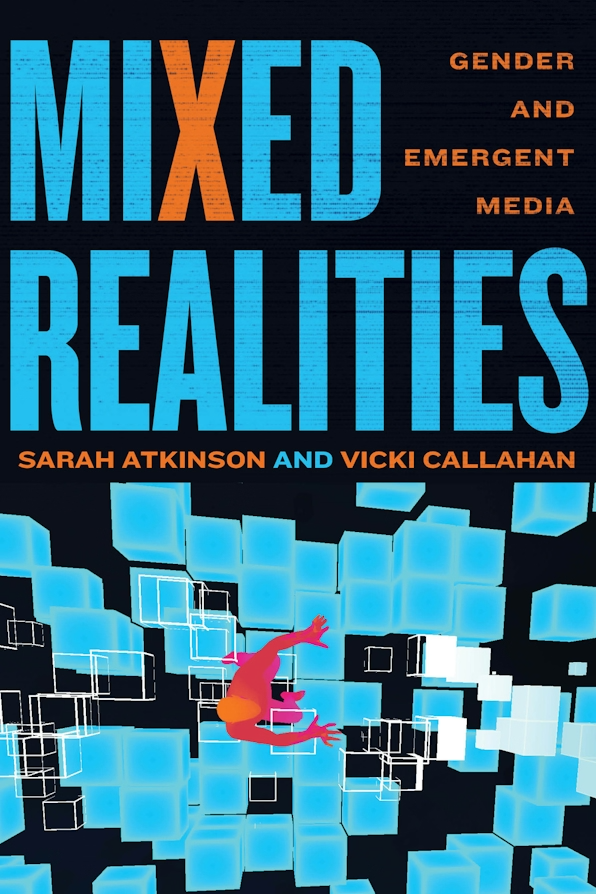
Sarah Atkinson and Vicki Callahan
Mixed Realities: Gender and Emergent Media
Wayne State University Press.
Judges’ comments:
This is an important book which uses the lens of gender (diversity) to explore the evolution of emerging media ‘realities’ such as VR and augmented reality across a range of (trans)media and immersive technologies including computing and gaming, retrieving and privileging the previously ignored contributions which women, non-binary and queer individuals have made to their development. The work draws on 100+ interviews undertaken between 2016 and 2022, and is structured around five distinct dimensions – people, platform, place, process, and production. The most important voices are those of the creators and makers who speak across the pages, narrating their challenges, achievements and innovations in their own words and pictures. The Appendices which comprise a description of the primary case studies and the participant biographies provide useful additional detail and the international dimension is another important aspect of the authors’ approach. The book makes a timely contribution to current debates around the importance of digital technologies, not least by showing both the relentless inequality of media industries globally but also the resilience and creativity of the women, non-binary and queer individuals who work within them.
SHORTLISTED
Shana MacDonald
The Art of Memes in Feminist Media Culture
Ohio State University Press.
Judges’ comments:
Lively and timely analysis of memes as acts of countercultural resistance which bring together art and politics. Importantly, the author discusses the revolutionary antecedents of meme culture making clear, as many commentators do not, that the meme is merely one of many iterations of political satire which has a long history, even as they acknowledge the specificity of their existence in this contemporary moment. The book is admirably succinct, with an introduction, followed by three ‘tactic’ chapters which focus on different meme tactics, described as collage, reenactment and assemblage, and a concluding chapter which considers future directions for activist meme culture, focusing on joy as a subversive activist approach. The analysis of the memes the author samples as mini-case-studies – both static (printed) and moving image (from TikTok) – is persuasive, and the book is engagingly written. It makes an original and thoughtful contribution to feminist and digital media scholarship.
SHORTLISTED
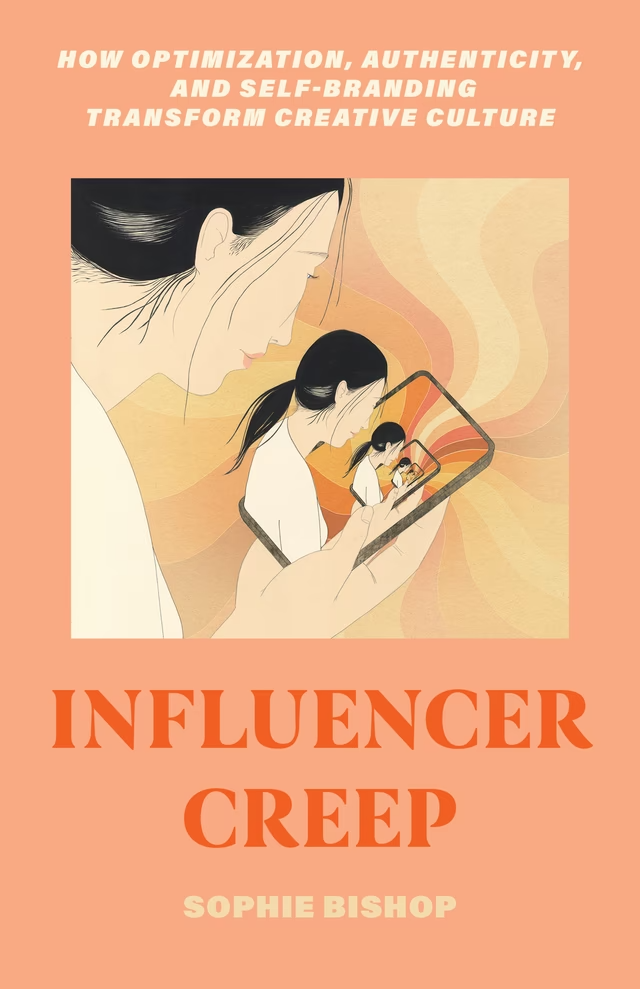
Sophie Bishop
Influencer Creep: How Optimization, Authenticity, and Self-Branding Transform Creative Culture
University of California Press.
Judges’ comments:
This is a significant contribution that explores how artists and artisans utilise digital platforms to promote themselves as brands and how this has become integral to their creative practices. Interrogating existing scholarship on internet influencers, authenticity, and optimization through empirical research, the book expands on creative labour and applies a feminist approach to the evolving relationships among artists’ online presence, influencer culture, and precarious labour. The book also more broadly illustrates the platformisation of everyday life and our work identity, building on the concept of self-branding and appropriately asserting the production of cultural values through artists-as-influencers’ algorithmic labour. This original research ensures ‘influencer creep’ will enter the academic vocabulary on digital platform culture and creative work.
SHORTLISTED
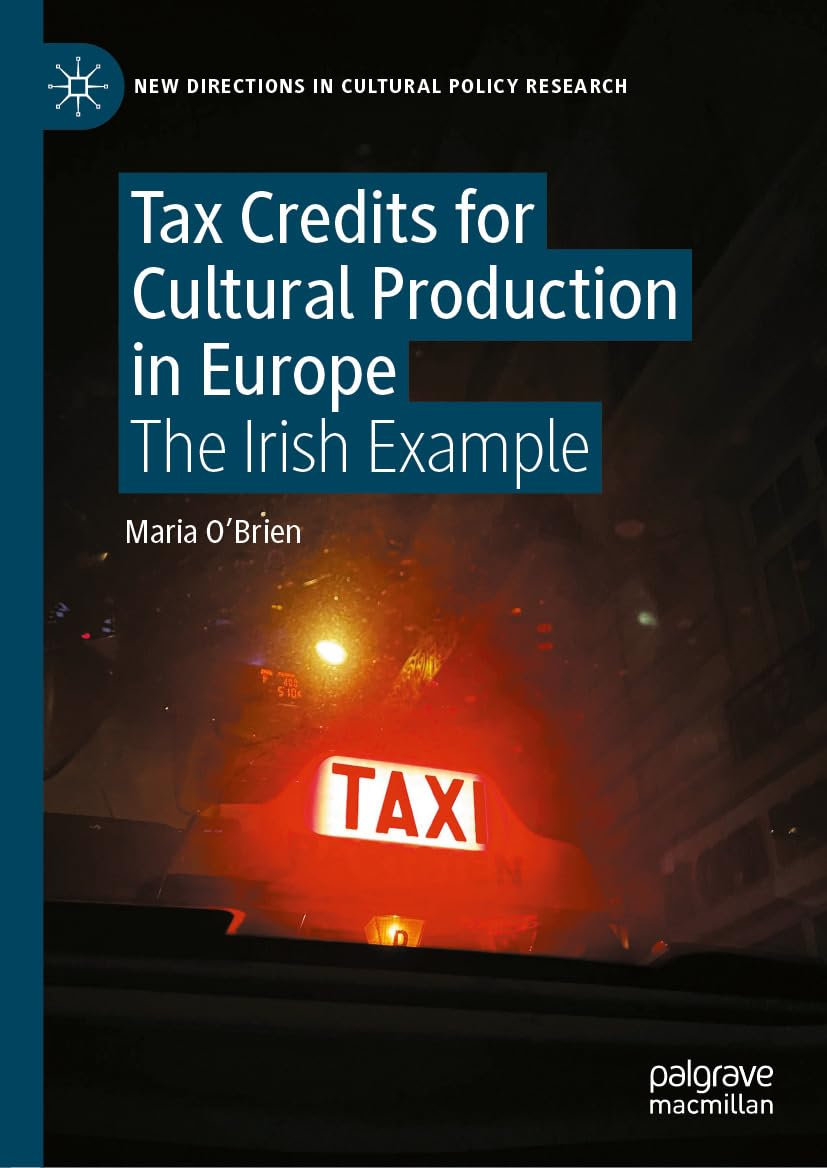
Maria O’Brien
Tax Credits for Cultural Production in Europe: The Irish Example
Springer Nature
Judges’ comments:
This bookprovides a very welcome analysis on the impact of the tax credit system in funding and fostering cultural production. Focusing on the tax credit system for audiovisual and digital games production in the Republic of Ireland, the author illustrates how such fiscal regimes operate as state-funded cultural production with an added examination of how Ireland’s relationship with the European Union frames tax credits as a form of cultural incentive. Drawing on legal and political economy perspectives alongside a spatial awareness of regulatory regimes, the book questions the relationship between the state and cultural policy through an economically motivated creative industries discourse. It’s a useful resource for anyone interested in global cultural policy, the role of the state in the neoliberalised creative economy and questions of cultural value.

SHORTLISTED
Edited by Tarik Sabry, Winston Mano and Andrea Medrado
Decolonising Approaches to Users and Audiences in the Global South Routledge
Judges’ comments:
This is a highly valuable and rigorous edited collection that is relevant to a wide range of media and cultural studies contexts. The editors have thoughtfully curated perspectives from a diverse set of contributors examining audience research across Africa, Asia, Latin America and the Middle East. Complemented by a substantive, in-depth introduction chapter, this work provides a methodological toolkit that makes a strong contribution to the decolonisation of audience research.
SHORTLISTED
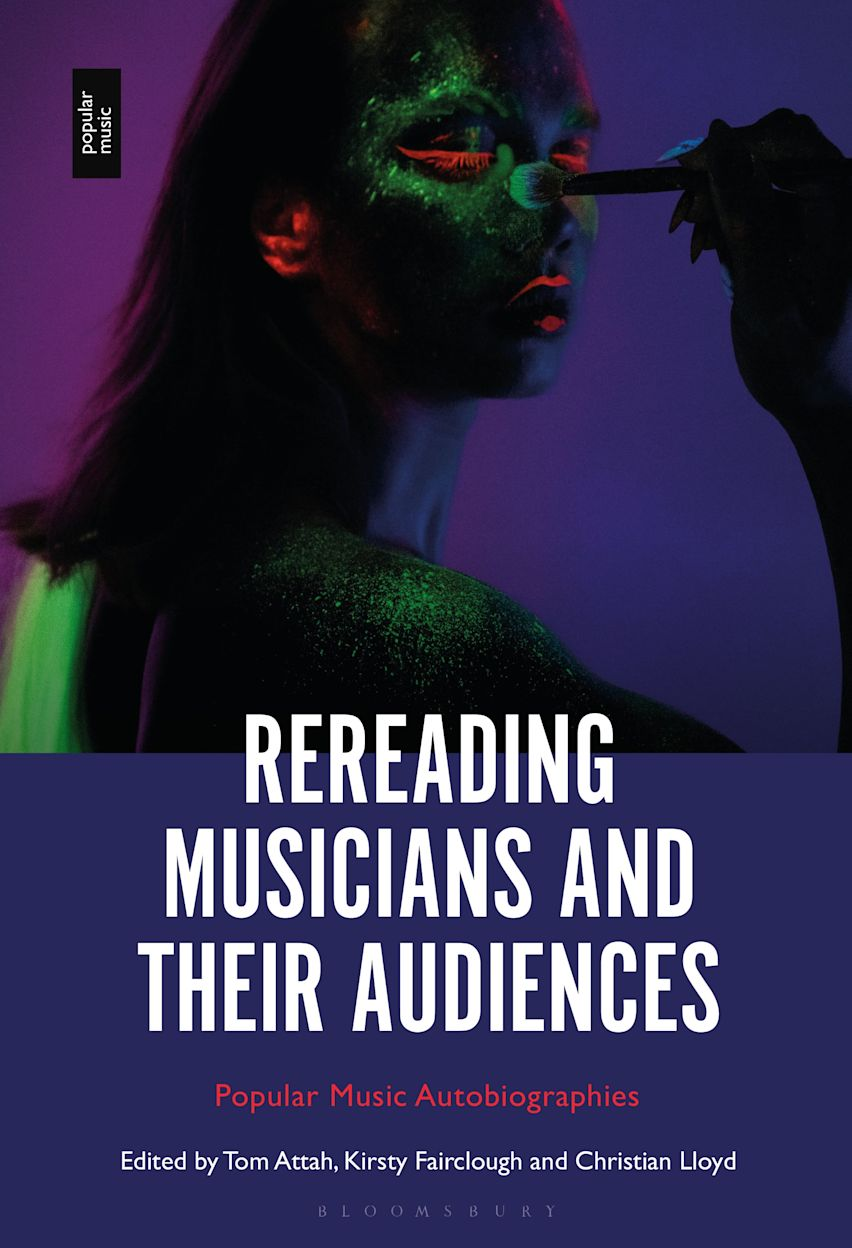
Edited by Tom Attah, Kirsty Fairclough and Christian Lloyd
Rereading Musicians and Their Audiences: Popular Music Autobiographies, Bloomsbury
Judges’ comments:
This is a great book that examines a wide variety of media used to construct biographies and autobiographies of musicians and artists. The editors have brought together a strong series of chapters that move beyond the usual focus on rock and pop, instead engaging with artists from a broader range of musical genres and diverse backgrounds. The introduction clearly outlines the purpose of the book, providing an effective overview of the chapters and highlighting the ways in which they intersect and speak to one another.

SHORTLISTED
Afraa Alyoussef (Sheffield Hallam)
Exploring the Experiences and Practices of Arab Female Cartoonists
Judges’ comments:
This insightful and detailed thesis lucidly outlines the many ways in which women around the world have been marginalised and often excluded from contributing to the creation of collective cultural and political knowledge. To address this issue, Alyoussef highlights Arab women cartoonists’ work with an eye to demonstrating how it can be used to challenge gender discrimination. Specifically, she examines the work of six practitioners, including herself, and how varying cultural and political landscapes have shaped and restricted efforts to publicly circulate their cartoons. Alyoussef draws insights from feminist and cultural theory and gathers evidence for her arguments utilising a multi-methods approach (interviews, textual/visual analysis, case studies and auto-ethnography). The thesis is clearly written, presented and logically structured overall. Its conclusion is reflexive and thoughtful, providing a wide-ranging discussion around the thesis’ core argument and multiple points of evidence gathered. Overall, the thesis is successful in its aims to provide broad ranging data which demonstrates how Arab women have been, and continue to be marginalised in their societies, through an examination of how women cartoonists have been denied or granted opportunities to have their voices heard, and in ways that challenge prevailing patriarchal norms. The thesis makes an original and engaging contribution to the feminist media studies and cultural studies literature around gender equality and media.
SHORTLISTED
Pankhuri Singh (University of Exeter)
Reimagining Shakespeare: A Journey through Vishal Bhardwaj’s Trilogy
Judges’ comments:
This fascinating, well written and presented thesis centres on an in-depth examination of Indian filmmaker Vishal Bhardwaji’s film adaptations of the Shakespearean dramas, Macbeth, Othello and Hamlet, for Indian audiences (Maqbool, Omkara, Haider). It offers a wide-ranging assessment of how he achieves this and the importance of his work for Indian cinema. These adaptations, Singh argues, demonstrate how globally malleable and relevant Shakespeare’s works are in the 21st century, focusing on how they have been adapted for an Inian context. Bhardwaj’s works, she argues, are nonetheless distinctive from source text and therefore have a continuing relevance to Indian society. The central contribution of this thesis lies in its analysis (“close readings”) of Bhardwaj’s Shakespearean trilogy demonstrating how his adaptations reconfigured Shakespeare texts as modern cultural texts and performances in their own right. He accomplished this by selecting aspects of Hindu mythology, Indian history, Bollywood, Indian customs and traditions, as well as previous adaptions of Shakespeare, opening up a new genre in Hindi filmmaking. The thesis has provided strong evidence for the enduring importance of Bhardwaj’s filmmaking for Indian cinema and the uniqueness of his film. Singh sums up the study clearly and thoughtfully, highlighting the challenges and future opportunities for further research on film adaptations. An interesting and original contribution to this field of academic knowledge.

SHORTLISTED
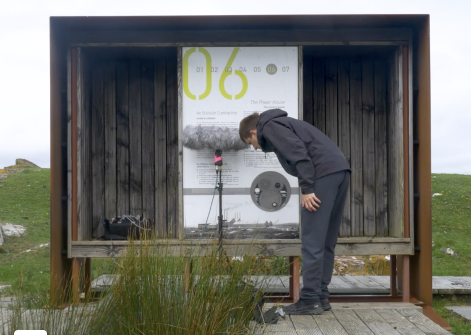
Matt Parker
Do Sheep Dream of Electrical Ruins? Encounters with Transatlantic Wireless Landscapes
Judges’ comments:
This interdisciplinary journal and film combine environmental humanities, media archaeology, and speculative documentary practices into a haunting work that reflects the nature of its subject, the Derrigimlagh bog in Ireland, site of the Marconi transatlantic wireless station. The ghostly voices of this past are conjured in contrast to the bleak, sheep grazed landscape of the present, providing reflection on the nature of technology and how the new inevitably becomes old and obsolete, reclaimed by nature. The combination of journal text and film presents both a poetic discourse and a historical analysis of the wireless telegraph & signal facility and the land on which it was situated. The work echoes with the memories of this past technology infrastructure and recounts not just the story of its presence but transmits to us the essence of this landscape and the resonance of its history. It offers insights and perspectives that are novel and offer new ways of thinking about history, geography and media, in particular it explores the notion of our sonic landscape. It advances the field in the way it is truly multi modal combining fieldwork, archival research and speculative documentary practice to explore media as an ecology of connected infrastructural elements. It is significant because of the way it reframes the various sites and ecological systems as living systems. It opens up these landscapes for new encounters and new understanding. Importantly, the exegesis frames the research as creative practice research and provides a means of disseminating methodological approaches to these kinds of subjects.
SHORTLISTED
Lúcia Nagib (University of Reading)
Judges’ comments:
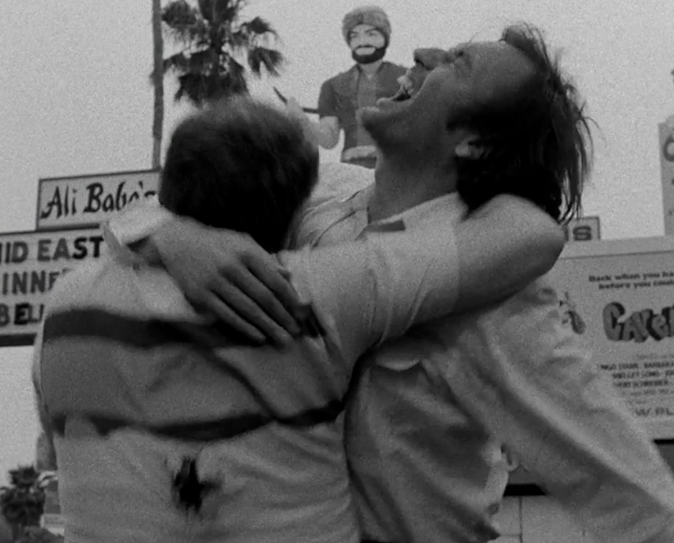
This film essay is an investigation of Wim Wender’s The State of Things (1982) positioning the film as a vehicle for a much larger engagement with cinematic entanglements, recounting the discourse of cinephilia, to reveal how films inspire audiences and filmmakers alike. In this period, a sharing of themes, actors, and even reels of film, is revealed, developing an interconnected landscape of global cinema. The work traces connections between the films of Wenders, Glauber Rocha and others of the period. Their films are discussed in the context of real and cinematic deaths, placing their work in time with contemporary interviews reflecting back on the period, revealing the significance of these films as epitomising the end of an era.
As practice-based research this film essay develops its discourse through interviews, edited sequences and montages that reveal connections and themes utilising the medium to engage the audience in a feast of film history.